Newsletter Subscribe
Enter your email address below and subscribe to our newsletter
Enter your email address below and subscribe to our newsletter

 ByJohn A
The landscape of undergraduate pre-law education and early law school courses in the United States represents one of the most intellectually rigorous transitions a student can face. Unlike standard humanities or social science courses that evaluate performance based on thematic summaries and descriptive essays, legal education demands an entirely different cognitive framework. In 2026, academic metrics across top tier US universities reveal that introductory Constitutional Law (Con Law) courses exhibit some of the steepest grading curves and highest initial drop-out rates. This is not due to a lack of student diligence, but rather a fundamental misunderstanding of structural methodology. Students are suddenly expected to process hundreds of pages of dense, historical Supreme Court opinions, extract the hidden operational legal principles, and apply those abstract concepts to highly complex, hypothetical fact patterns.
For the uninitiated, reading an unedited judicial opinion from the 19th century can feel like learning a foreign language. The structural density of the text, combined with the pressure of the Socratic method in American lecture halls, creates an environment ripe for academic anxiety. To survive this initial trial by fire, students must treat legal studies less like an exercise in raw memorization and more like an exercise in architectural logic. Success is determined by how efficiently you can deconstruct a massive judicial decision into a clean, actionable reference document. Implementing a systematic study routine is essential; just as modern STEM students rely on structured technical assets to master coding logic, ambitious pre-law students must actively seek out high-quality law assignment help to quickly internalize the complex case layouts and analytical workflows required by modern professors.
The structural importance of mastering this baseline methodology early cannot be overstated. Data from the Law School Admission Council (LSAC) and empirical studies on legal education trends show a direct correlation between a student’s undergraduate performance in rigorous legal reasoning courses and their long-term retention rates in J.D. programs. Furthermore, the modern US legal market is evolving rapidly. Firms are increasingly prioritizing graduates who possess flawless analytical clarity and the ability to synthesize massive quantities of conflicting case law on tight operational deadlines. If you are currently sitting at your desk surrounded by highlighter pens, feeling completely overwhelmed by terms like stare decisis, certiorari, or substantive due process, recognize that you are simply encountering a standard learning curve. Overcoming this hurdle requires shifting away from passive reading habits and adopting the precise, standardized toolkits utilized by working legal professionals.
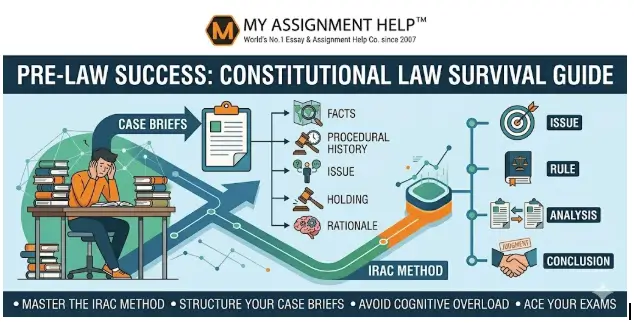
The absolute foundation of surviving any constitutional law course is learning how to write a legal brief that transforms a 40-page judicial opinion into a single page of high-yield notes. Beginners frequently make the mistake of highlighting entire pages of text, which merely delays the actual processing of information. A professional brief is highly structured and must always contain five distinct segments: the facts of the case, the procedural history (how the case moved through lower courts), the specific legal issue presented to the court, the holding (the court’s ultimate decision), and the detailed rationale behind that choice.
When isolating the facts, focus exclusively on the legally operative details. Ask yourself: If this specific fact were altered, would the court’s final ruling change? If the answer is no, leave it out of your brief. The most critical component, however, is the “rationale” or the ratio decidendi. This is where the court explains its constitutional interpretation—whether it relies on original intent, textualism, historical precedent, or a living constitution framework. Documenting this specific logic allows you to anticipate how the court might rule on future, unwritten scenarios, which is precisely how constitutional law professors construct their midterm and final exams.
When exam day arrives in a US law course, the greatest danger is not a lack of knowledge, but a lack of structural discipline. Professors do not want to read unstructured stream-of-consciousness essays or generalized historical summaries of the Constitution. They want to see an objective, mechanical application of law to facts. The definitive industry standard for this process is the IRAC method for law students, an acronym that stands for Issue, Rule, Analysis, and Conclusion.
+——————————————————-+
| ISSUE |
| Isolate the precise constitutional question raised |
| by the specific fact pattern provided. |
+—————————-+————————–+
|
v
+——————————————————-+
| RULE |
| State the governing judicial doctrine or Supreme |
| Court precedent cleanly, without adding facts. |
+—————————-+————————–+
|
v
+——————————————————-+
| ANALYSIS |
| The core engine: Heavily compare the exam facts |
| directly to the facts of the established precedent. |
+—————————-+————————–+
|
v
+——————————————————-+
| CONCLUSION |
| Provide a definitive, single-sentence prediction |
| of the court’s likely final holding. |
+——————————————————-+
The “Analysis” section is the core engine of your entire exam grade and deserves the vast majority of your time and structural focus. This is where you engage in explicit factual analogies and distinctions. For example, if your exam problem involves a modern digital privacy issue, you must explicitly compare it to the landmark metadata rulings in Carpenter v. United States. You must write sentences like: “Much like the continuous cellular tracking in Carpenter, the drone surveillance in this scenario constitutes a systematic intrusion into an individual’s reasonable expectation of privacy.” Showing the professor exactly how the facts of your hypothetical problem mirror or diverge from established Supreme Court precedent is how you secure an A-grade.
To maintain an exceptional GPA while managing the sheer volume of reading required by pre-law or political science curricula, students must implement tactical time-management frameworks. First, always read the assignment prompt backward. Before diving into a complex fact pattern or case file, skip directly to the very end of the document to read the specific call of the question. Knowing whether you are expected to write an objective office memorandum, a persuasive appellate brief, or a policy recommendation fundamentally alters how you process the preceding information, saving you hours of redundant reading time.
Secondly, build your outlines around legal elements rather than chronological class dates. A highly effective outline should serve as an operational index of actionable rules. For instance, if you are studying the Commerce Clause, your outline should display a clear, sequential checklist based on the framework established in United States v. Lopez:
Having these pre-formatted checklists memorized and ready to deploy ensures that you never miss a critical step during high-stress exam conditions.
See also:How Automation Is Changing Manufacturing Industries
An overlooked challenge for modern pre-law undergraduates is the rise of interdisciplinary degree programs. In an increasingly data-driven market, many political science and pre-law majors take elective courses in computing, statistics, or data analytics to build quantitative skills. This can create a massive cognitive imbalance. A student might spend their morning analyzing 14th Amendment jurisprudence using qualitative reasoning, and their afternoon staring at a broken IDE terminal attempting to debug a nested loop for a data processing elective.
When structural workloads from these tech electives clash with rigorous legal writing deadlines, academic burnout becomes a real threat. During intense midterms, an overwhelming sense of cognitive overload can tempt a student to search online for options to pay someone to do my programming homework simply to protect their legal study hours. Understanding how to delegate or seek specialized assistance for secondary, technical tasks is a critical component of maintaining a stellar GPA across a diverse, modern college curriculum.
As higher education workloads intensify across specialized professional tracks, the old-school mentality of struggling through deep conceptual roadblocks in complete isolation has been replaced by a highly pragmatic approach to resource management. Modern pre-law students are frequently managing intense schedules: competitive internships on Capitol Hill, local legal aid volunteer work, LSAT preparation, and demanding multi-disciplinary course requirements. In this highly competitive environment, knowing when to leverage professional academic networks is not a vulnerability—it is a clear sign of superior executive functioning and strategic acumen.
When the conceptual gap between an abstract classroom lecture and a highly technical essay prompt becomes unmanageable, collaborating with specialized editorial services provides students with a flawless, interactive learning blueprint. Reviewing a professionally drafted case analysis or a perfectly structured legal brief tailored exactly to your specific university curriculum guidelines functions as an individualized masterclass. Rather than wasting dozens of hours in state of complete paralysis, analyzing a polished reference document allows a student to reverse-engineer the structural logic, internalize the appropriate professional tone, and master complex case citations far faster than unguided trial and error. This shifts the dynamic from blind frustration to active, visual learning, equipping non-traditional and pre-law students alike with the exact analytical toolkits needed to preserve their competitive GPAs.
Unlike courses that evaluate students on qualitative summaries, Constitutional Law requires absolute binary precision mixed with flexible argumentative logic. You must memorize rigid legal tests developed by the Supreme Court and apply them to completely unique, messy real-world scenarios using strict legal frameworks.
The most frequent error is blending the Rule and Analysis sections together, or skipping the Analysis section entirely to jump straight to the Conclusion. Students often state the legal rule and immediately give their opinion without performing the detailed, line-by-line factual comparisons that law professors actually grade on.
A highly effective case brief should rarely exceed one to two pages. The entire purpose of a brief is condensation and clarity. If your brief is as long as the unedited judicial opinion itself, you have not successfully isolated the operative legal principles from the surrounding dicta.
No. In fact, professional legal industries operate entirely on precedent, collaborative templates, and established reference models. Reviewing a professionally structured document provides a clean architectural baseline that helps you understand what a flawless, high-authority legal analysis looks like, significantly accelerating your independent writing proficiency.
Kara Betty is a senior academic strategist and lead legal writer representing the MyAssignmentHelp Editorial Team. As a premier collective of legal education analysts, veteran academic consultants, and senior professional writers, the team operates at the absolute cutting edge of modern digital pedagogy and specialized student support. Together, they produce comprehensive, data-driven reference materials and instructional frameworks designed to help pre-law and professional track students navigate the rigorous complexities of modern university curriculums across the United States.